



T-31 (Cartalax) and Cellular Aging: How the AED Tripeptide Modulates Senescence, Renewal, and Stress Pathways
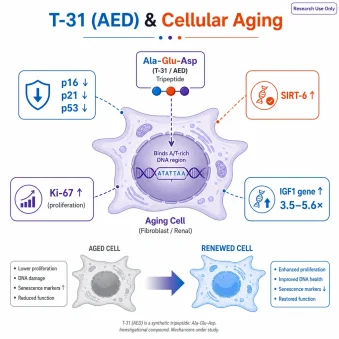
T-31 — the tripeptide alanine–glutamate–aspartate (AED), also known as Cartalax — is a Khavinson short peptide studied as a gene-regulating "bioregulator." This research-use-only review examines how, in aged cell cultures, T-31 is reported to lower senescence markers (p16, p21, p53), raise SIRT-6, reduce apoptosis, and shift fibroblasts and renal epithelium toward a more renewal-oriented state — and why researchers frame its mechanism at the level of chromatin.
Research-use-only disclaimer: T-31 (Cartalax) is intended strictly for in-vitro and laboratory research use. It is not a drug, supplement, or anti-aging peptide therapy, and it is not intended for human or veterinary use. Every finding below is drawn from cell-culture or animal-derived tissue models and is described in hedged, mechanistic terms. Nothing here is medical advice.

TL;DR
T-31 (Ala-Glu-Asp / Cartalax) is a Khavinson short peptide studied as a chromatin-level bioregulator. In aged fibroblast and renal cell cultures, research links it to lower p16, p21, p53, higher SIRT-6 and Ki-67, lower caspase-3 and MMP-9, and IGF1 gene upregulation (reported 3.5–5.6-fold in stem-cell models). Proposed mechanism: sequence-selective binding to A/T-rich DNA. Research use only.
Identity: AED tripeptide (Cartalax), one of the Khavinson short-peptide bioregulators.
Senescence: reported reductions in p16, p21, and p53 (~1.33-fold p53) with increased SIRT-6 in aged renal cultures.
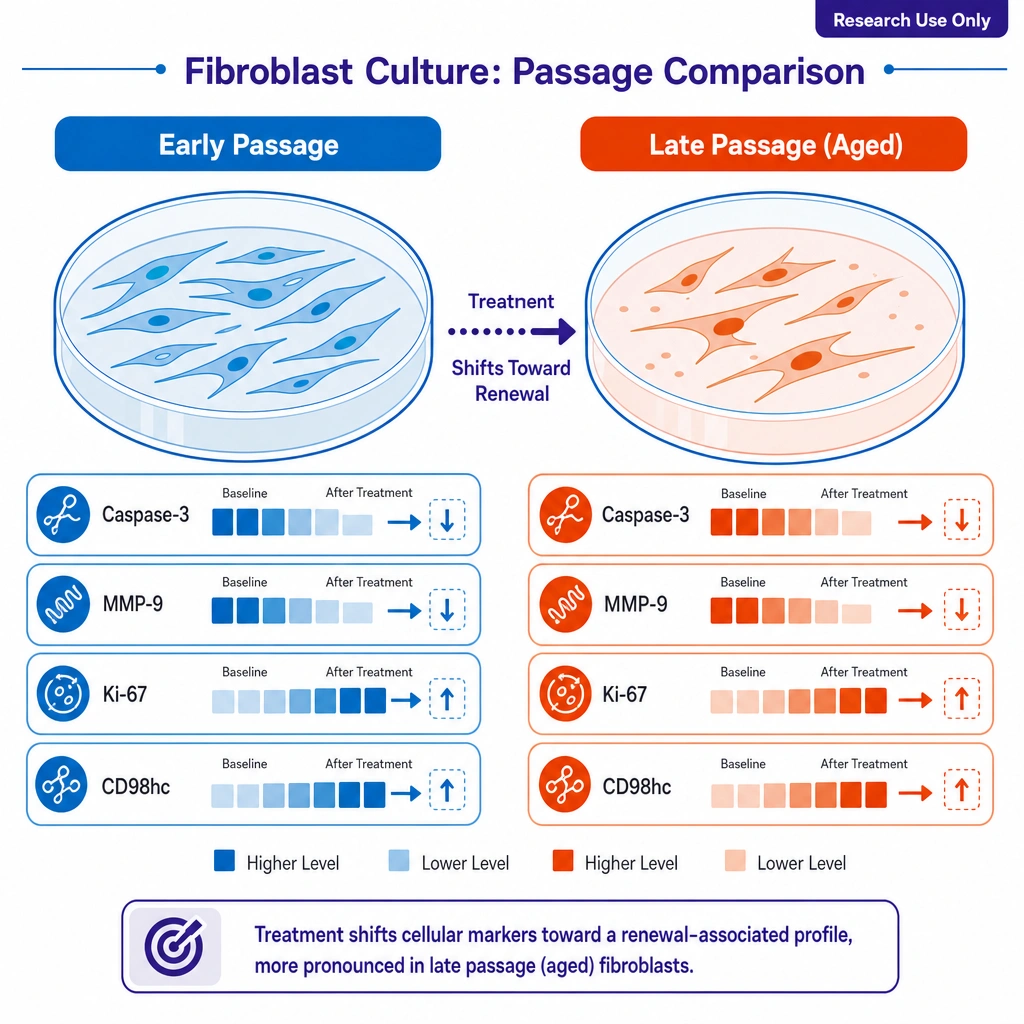
Fibroblasts: higher Ki-67 and CD98hc, lower caspase-3 and MMP-9 — a renewal-oriented profile.
Gene regulation: IGF1 up ~3.5–5.6-fold in MSC aging cultures; modulation of TNKS2, plus FOXO1/TERT/NF-κB examined.
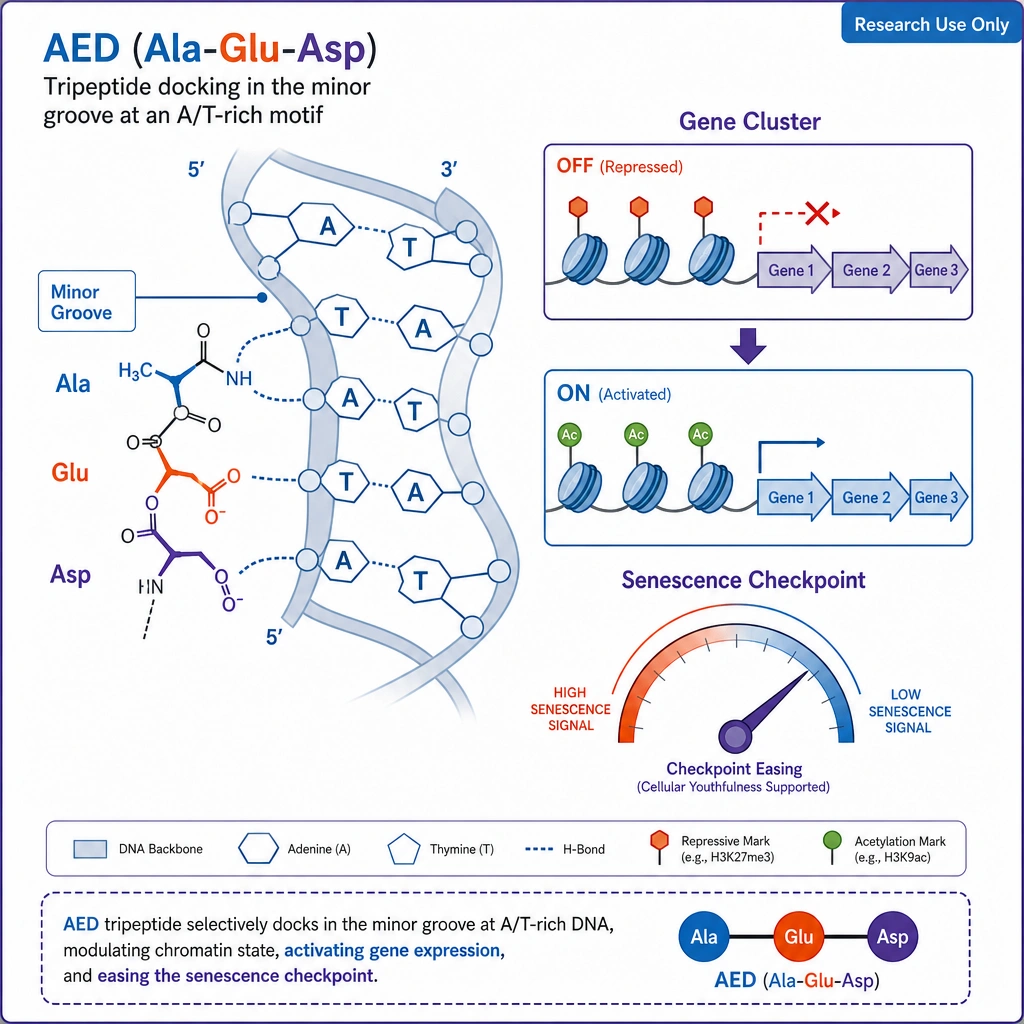
Mechanism: proposed sequence-selective binding to A/T-rich DNA motifs (chromatin-level, not receptor-mediated).
What Is T-31 (Cartalax) and What Family Does It Belong To?
T-31 is a synthetic tripeptide of the sequence Ala-Glu-Asp (AED), commonly called Cartalax. Structurally it belongs to the family of Khavinson short peptides — oligopeptides that some investigators describe as peptide bioregulators on the basis that they may interact with chromatin and modulate transcription of specific gene clusters.
The unifying hypothesis for this family, articulated by Khavinson et al. (2016), is that very short peptides can enter cells and the nucleus and bind DNA at defined motifs. In that work, spatial models of DNA–peptide complexes were built for 19 short peptides; notably, AED-type sequences were associated with binding to specific short DNA motifs (e.g., "acct"-type and A/T-rich sequences), distinguishing its mechanism from mitochondrial peptides like elamipretide (Bendavia), also known as the ss-31 peptide, which is often studied in the context of Barth syndrome. This DNA-binding framing is what lets researchers treat T-31 as a transcription-level tool rather than a classical receptor ligand or a mitochondrial-targeted peptide targeting the inner mitochondrial membrane.
How Does T-31 Affect Fibroblast Aging?
Fibroblasts cultured to different passage numbers are a standard model of cellular aging, and this is where much of the T-31 data begins. Work by Lin'kova et al. (2016) examined AED across early- and late-passage skin fibroblasts.
The reported pattern points toward renewal rather than decline. T-31 was associated with elevated Ki-67 (a proliferation marker) and CD98hc (a glycoprotein involved in amino-acid transport and integrin-linked signaling), alongside reduced executioner caspase-3 in both young and aged cultures — leading the authors to state that the peptide "reduced the level of apoptosis in young and aged cell cultures." In late-passage cells, MMP-9 (a protease tied to excessive matrix breakdown in aged tissue) was also decreased. Taken together, reduced caspase-3 and MMP-9 with elevated Ki-67 and CD98hc were interpreted as a less catabolic, more renewal-oriented fibroblast phenotype.
What Does T-31 Do in Renal Epithelial Aging?
The renal system is the other major model, though some bioregulators are also explored in tissues relevant to heart failure, primary mitochondrial myopathy, or models of neuroprotection, such as Alzheimer’s research. Studies by Khavinson et al. (2014) exposed in-vitro-aged primary kidney cultures to T-31 alongside a calf-kidney polypeptide complex, tracking Ki-67, p53, MMP-14, and IL-8 by immunocytochemistry.
Complementary observations by Chalisova et al. (2015) in kidney tissue cultures from young and old animals were consistent — increased Ki-67 signal and decreased p53 in aged renal cultures. The authors interpret this less as T-31 forcing proliferation and more as it dampening pro-apoptotic signaling, with the magnitude varying by culture system and donor age.
How Does T-31 Influence p16, p21, and SIRT-6?
Beyond p53, T-31 has been linked to canonical senescence markers. Further renal work by Khavinson et al. (2014, Adv Gerontol) reported reductions in the cyclin-dependent kinase inhibitors p16 and p21 — both commonly used to define a senescent state — consistent with a partial release of the senescence checkpoint in aged renal cultures.
In parallel, the same group reported an increase in SIRT-6 transcript and protein. SIRT-6 is a chromatin-associated enzyme implicated in DNA repair, telomeric chromatin maintenance, and metabolic regulation, and its decline is associated with cellular senescence. An apparent T-31-linked rise in SIRT-6, set against falling p16/p21 and potentially lower ROS levels, is read as a potential counter-senescent signature. Mechanistically, the authors tie these effects back to the DNA-binding hypothesis — proposing that AED forms energetically favorable complexes with A/T-rich motifs such as d(ATATATATAT)2, modulating local chromatin accessibility rather than acting through a surface receptor.
Does T-31 Regulate Genes and Stem-Cell Differentiation?
Gene-expression studies give the sharpest numbers. Ashapkin et al. (2020) tested AED (and related peptides KED and KE) on human mesenchymal stem-cell (MSC) aging cultures, measuring IGF1, FOXO1, TERT, TNKS2, and NF-κB.
T-31 also intersects with stem-cell differentiation. Work by Linkova et al. (2023) in a chondrogenic model reported that AED modulates TNKS2 (tankyrase 2), a gene involved in telomere maintenance, Wnt signaling, and mitotic regulation. In differentiation assays, AED at an effective concentration near 200 ng/mL increased chondrocyte numbers by roughly 1.4–1.8× in young cultures and 1.6–2.1× in older cultures versus control — suggesting the peptide can bias fate decisions in mesenchymal cells, with the direction and magnitude depending on passage and protocol.
| Marker | Reported direction | Model | Role |
|---|---|---|---|
| p53 | ↓ ~1.33× | Aged renal epithelium | Pro-apoptotic |
| p16 / p21 | ↓ | Aged renal epithelium | Senescence checkpoint |
| SIRT-6 | ↑ | Aged renal epithelium | Counter-senescent |
| Ki-67 | ↑ (~2× proliferation) | Fibroblast / renal | Proliferation |
| Caspase-3 | ↓ | Fibroblasts | Apoptosis |
| MMP-9 | ↓ | Late-passage fibroblasts | Matrix breakdown |
| IGF1 (gene) | ↑ ~3.5–5.6× | MSC aging cultures | Growth/renewal |
| Chondrocyte number | ↑ ~1.4–2.1× | Chondrogenic model | Differentiation |
What About Cellular Stress Resistance?
The renewal-oriented profile ties into stress resistance, potentially aiding cells in managing oxidative stress, ATP synthesis, energy production, and mitochondrial dysfunction, similar to the metabolic regulation studied with mots-c. Because SIRT-6 participates in DNA repair and telomeric chromatin maintenance, and TNKS2 is linked to telomere stability and Wnt-dependent fate decisions, an AED-associated rise in these factors is interpreted as compatible with better-supported genome maintenance, mitochondrial health, mitochondrial respiration, and stable ATP production in aged cultures. Likewise, reduced caspase-3 and MMP-9 suggest a cellular environment less primed for apoptosis—often triggered by the oxidation of the phospholipid cardiolipin and subsequent release of cytochrome c by reactive oxygen species—and matrix catabolism under the strain of replicative agin
Importantly, these are correlative, model-dependent observations. The proposed chromatin-binding mechanism remains a hypothesis, and the magnitude of every effect varies with the specific aging protocol, passage number, and donor tissue — unlike direct interventions on the electron transport chain—which is why T-31 is best understood as a research probe of age-associated transcriptional programs, not a demonstrated intervention.
How is research-grade T-31 characterized?
Because AED is a very short peptide, identity confirmation and purity are the meaningful quality questions for reproducible transcriptional assays. Research-grade T-31 is typically verified by reversed-phase HPLC for purity and mass spectrometry for identity, handled cold, and supplied for laboratory use only. At PrymaLab, research peptides are characterized with HPLC/MS verification and independent third-party testing. No specific lot data are asserted in this general reference.
Frequently Asked Questions
What is T-31 (Cartalax)?
T-31 is the tripeptide Ala-Glu-Asp (AED), also called Cartalax, a Khavinson short peptide studied as a chromatin-level bioregulator in aging cell cultures. It is for research use only.
How does T-31 affect senescence markers?
In aged renal cultures it reportedly lowers p16, p21, and p53 (~1.33-fold p53) and raises SIRT-6 — a pattern interpreted as counter-senescent in these models.
Does T-31 regulate gene expression?
Yes. Ashapkin et al. (2020) reported IGF1 gene expression up ~3.5–5.6-fold in MSC aging cultures, with FOXO1, TERT, TNKS2, and NF-κB also examined; AED is proposed to bind A/T-rich DNA motifs.
What does T-31 do in fibroblasts?
Lin'kova et al. (2016) reported higher Ki-67 and CD98hc and lower caspase-3 and MMP-9 — a renewal-oriented, less catabolic fibroblast phenotype.
Does T-31 influence stem-cell differentiation?
In a chondrogenic model, AED at ~200 ng/mL increased chondrocyte numbers ~1.4–1.8× (young) and ~1.6–2.1× (old) versus control and modulated TNKS2.
Is T-31 approved for human use?
No. T-31 (Cartalax) is research-use-only, studied only in cell and tissue models, and is not intended for human or veterinary use.
References
- Lin'kova NS, Drobintseva AO, Orlova OA, et al. Peptide Regulation of Skin Fibroblast Functions during Their Aging In Vitro. Bull Exp Biol Med. 2016;161(1):175–178. PMID:27259496
- Khavinson VKh, Lin'kova NS, Polyakova VO, et al. Peptides regulate the expression of signaling molecules in kidney cell cultures during in vitro aging. Bull Exp Biol Med. 2014;157(2):261–264. PMID:24958378
- Chalisova NI, Lin'kova NS, Nichik TE, et al. Peptide Regulation of Cell Renewal Processes in Kidney Tissue Cultures from Young and Old Animals. Bull Exp Biol Med. 2015;159(1):124–127. PMID:26033601
- Khavinson VKh, Tarnovskaia SI, Lin'kova NS, et al. Tripeptides slow down the aging process in renal cell culture. Adv Gerontol. 2014;27(4):651–656. PMID:25946838
- Linkova N, Khavinson V, Diatlova A, et al. Peptide Regulation of Chondrogenic Stem Cell Differentiation. Int J Mol Sci. 2023;24(9):8415. PMC10179481
- Ashapkin V, Khavinson V, Shilovsky G, Linkova N, Vanyushin B. Gene expression in human mesenchymal stem cell aging cultures: modulation by short peptides. Mol Biol Rep. 2020;47(6):4323–4329. doi:10.1007/s11033-020-05506-3
- Khavinson VK, Lin'kova NS, Tarnovskaya SI. Short Peptides Regulate Gene Expression. Bull Exp Biol Med. 2016;162(2):288–292. PMID:27909961
Final disclaimer: This article is an educational research reference. T-31 (Cartalax) is sold and studied for laboratory research use only, is not approved by any regulatory authority, and is not intended for human or veterinary use. Statements about T-31 have not been evaluated by the FDA. Nothing here should be interpreted as medical or anti-aging advice.
Mechanistic descriptions are hypotheses and observations from in-vitro and animal-derived tissue models; the proposed DNA-binding mechanism is unconfirmed and effects may not generalize. Always verify the legal status of any research compound in your jurisdiction before purchase or use.